
Rings and Toolkits: A Technical Deep Dive into nnet, and How It Compares to libp2p
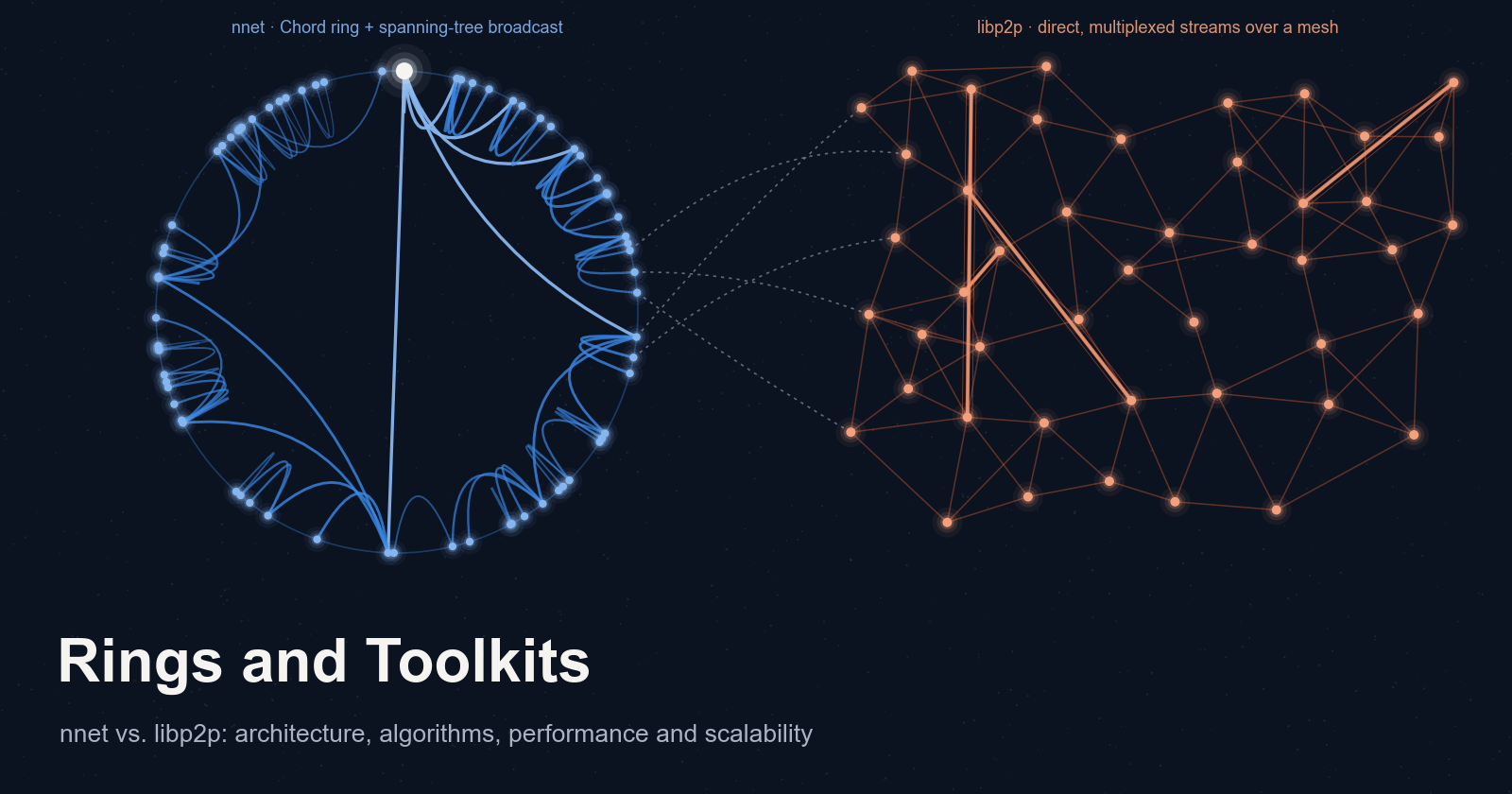
How NKN’s Chord-based overlay and Protocol Labs’ modular networking stack take very different approaches to peer-to-peer networking: architecture, algorithms, performance and scalability.
A technical deep dive into nnet, NKN’s Chord-based overlay network, and how it compares to libp2p. It covers architecture, core algorithms, performance and scalability, and includes a side-by-side benchmark you can rerun.

The gist in one picture

Both get called “p2p network stacks”, but they solve different problems:
- nnet is an overlay network. Every node joins one structured topology, an enhanced Chord ring. You hand nnet some bytes and a 256-bit key, and the network carries the message hop by hop to whichever node owns that key. The core is about 5,300 lines of Go.
- libp2p is a connectivity toolkit. Its job is to let any peer open an authenticated, encrypted, multiplexed stream to any other peer, over any transport and through NATs. Overlays such as the Kademlia DHT and GossipSub are separate modules. They help you find peers or spread messages, but data normally travels over a direct connection.
nnet’s core operation is “route this message through the network”. libp2p’s is “open a secure stream to that peer”. Almost every other difference follows from that one choice.
At a glance
| nnet | libp2p | |
|---|---|---|
| Core abstraction | Message routed over a Chord overlay | Secure, multiplexed stream to a peer |
| Identity | Arbitrary 32-byte ID (application decides) | PeerID = hash of a public key, verified in the handshake |
| Transports | TCP, KCP | TCP, QUIC, WebSocket, WebTransport, WebRTC, … |
| Security | None built in (added through middleware) | Noise or TLS 1.3, mandatory |
| Message to a non-neighbor | Multi-hop relay, ≈ ½·log₂N hops | DHT lookup, then a direct dial (hole punching if needed) |
| Network-wide broadcast | Chord spanning tree (≈ 1 send per node) or flooding | GossipSub mesh (≈ 6 eager sends per node) plus lazy gossip |
| NAT traversal | UPnP / NAT-PMP | AutoNAT v2, Circuit Relay v2, DCUtR (≈ 70% hole-punch success) |
| Overload | Bounded channels that drop messages | Flow-controlled streams plus a hierarchical Resource Manager |
| Languages | Go | Go, Rust, JS/TS, Nim, Java, C++, Python, Zig, .NET, … |
Key findings
1. nnet’s spanning-tree broadcast is its standout idea. The Chord finger table already defines a spanning tree rooted at any node. Each node forwards only to the fingers below the arc its sender delegated to it, so every node receives the message about once and the tree is at most log₂N hops deep. (§3.5)

2. Its default configuration has a trap. Duplicate filtering is enabled only for flooded messages, not tree messages. With one node per finger (K = 1) a few duplicates leak through, which is harmless. With redundancy (K = 3), duplicates re-propagate: in a 60-node local test, the tree cost more than flooding (56 vs. 37 sends per node), and simulation puts it at about 7,100 sends per node at 10,000 nodes. Adding BROADCAST_TREE to LocalRxMsgCacheRoutingType (one config line) brings it down to 4.5. (§3.5)
3. Side by side, both stacks scale flat for broadcast. nnet is leaner but less reliable. I benchmarked both from 16 to 256 nodes under identical conditions: same harness, same messages, constant total load, and libp2p security off to match nnet. (§7.4)
| Broadcast, 1 KB messages | Wire bytes per delivered byte | CPU per delivery | Delivered |
|---|---|---|---|
| nnet tree, K = 1 | 1.3–1.4 | 130–185 µs | 98.4–100% |
| nnet tree, K = 3 | 3.5–5.6 | 410–550 µs | 100% |
| GossipSub | 6.9–8.3 | 530–640 µs | 100% |
| nnet flooding | 15–23 | ≈ 1.6 ms | saturated the machine from 32 nodes |
The single-copy tree is about 5× leaner on the wire and 3.5× cheaper in CPU than GossipSub. It still lost up to 1.6% of deliveries, and some nodes missed up to 11%, even with no nodes joining or leaving. With enough redundancy to deliver everything, it costs about the same as GossipSub.
4. For point-to-point messages, the winner depends on how many peers each node talks to. With random destinations, libp2p’s direct streams are 2–3× cheaper while every node can stay connected to every other node. But their connection count grows linearly with N, and per-message CPU rose 4.6× from 128 to 256 nodes. nnet’s relay grows only logarithmically. Given the same connection budget, nnet’s relay was cheaper from 128 nodes upward.

Scaling elasticity is how cost per delivery grows with network size: 0 means flat, 1 means proportional to N.
5. nnet pays to stay connected; libp2p pays on demand. With no traffic, each nnet node still sends 0.7–1.5 KB/s of pings and Chord stabilization traffic to its O(log N) neighbors. libp2p sent no stream-level traffic while idle.
6. Security is the biggest practical gap. nnet doesn’t bind node IDs to keys, has no encryption, and has no per-peer resource limits; all of these are left to the application. In libp2p they are mandatory, and in the benchmark Noise encryption plus signing added at most about 15% to GossipSub’s wire bytes and no measurable CPU cost. (§8)
Which one should you use?
nnet (or its design) fits when your application is naturally key-addressed, nodes are publicly reachable servers or incentivized operators, you need cheap network-wide broadcast of high-volume, loss-tolerant data, or you want a deterministic, verifiable topology so that relaying can be audited or rewarded.
libp2p fits when peers are heterogeneous (browsers, phones, NATed home machines, many languages), you need security by default, traffic is session-oriented between known peers, or you need topic-based pubsub that holds up under attack.
Or combine them. nnet’s two best ideas, key-based relay with latency-aware next hops and finger-table tree broadcast, could run as a libp2p protocol and inherit libp2p’s identity, encryption and NAT traversal. (§10)